Buy-Peptides UK
Loading product
SYS//LAB-01 · UK Domestic Warehouse · Secure Session
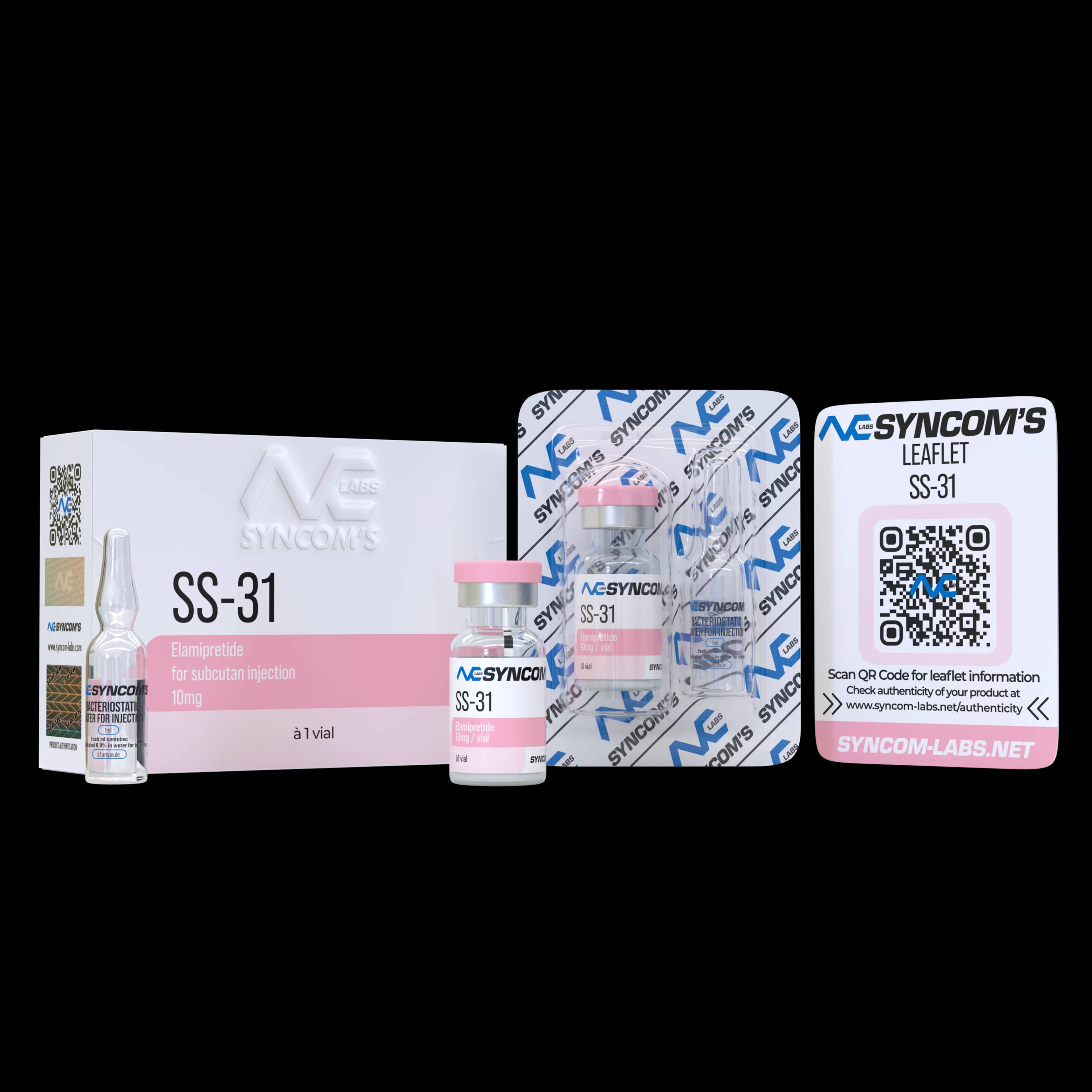
SS-31 is the Szeto-Schiller cardiolipin-binding tetrapeptide, sequence D-Arg-Dmt-Lys-Phe-NH2, the same molecule Stealth BioTherapeutics took into Barth syndrome trials as elamipretide. UK research stock, HPLC and MS on every lot, batch CoA refund cover.
| Molecular Formula | C₃₂H₄₉N₉O₅ |
| Sequence | D-Arg-Tyr(2,6-diMe)-Lys-Phe-NH₂ (4 aa) |
| Storage | -20°C lyophilised; 2-8°C reconstituted |
| Form | Vial |
Payment Methods
Shipping & Returns
SS-31 came out of a collaboration most peptide listings never mention. Hazel Szeto at Weill Cornell Medical College was looking at mitochondrial protection in injured cells. Peter Schiller at the Clarke Institute of Psychiatry in Toronto was a synthetic chemist who had spent years engineering small peptides that could cross membranes without being chewed up by aminopeptidases. The two of them put together a short series of cationic tetrapeptides, alternating aromatic and basic residues, and the fourth in the series, abbreviated SS-31, turned out to do something none of them had been hunting for. It concentrated inside mitochondria and stuck to cardiolipin on the inner membrane.
The SS letters in the molecule's name are the authors' initials. The series shares a common scaffold: a positively charged residue, an aromatic residue, another basic residue, an aromatic residue, and an amidated C-terminus. For SS-31 specifically, the sequence is D-Arg-Dmt-Lys-Phe-NH2. The D-arginine resists trypsin-class cleavage. The dimethyltyrosine, abbreviated Dmt, is the workhorse: two methyl groups on the tyrosine ring shift its electronics enough that the peptide partitions into the inner mitochondrial membrane on its own, without a transporter, and parks against cardiolipin's twin phosphate head groups.
This is where the SS-31 file diverges sharply from the other mitochondrial peptides on this site. MOTS-c is a 16-residue mitochondrial-derived peptide encoded inside the 12S rRNA locus of mtDNA, and the published assays cluster around AMPK phosphorylation. Humanin is a 24-residue MDP encoded at the 16S rRNA locus and the dominant mechanism in its literature is BAX inhibition. Both are endogenous. Both are read off mitochondrial DNA. SS-31 is none of that. It is a fully synthetic tetrapeptide designed at the bench by two academic groups, and its mechanism is direct binding to cardiolipin, the signature phospholipid of the inner mitochondrial membrane. That binding is the proposed reason for the downstream effects on cytochrome c stabilisation and reactive oxygen species suppression that the Szeto group reported across a decade of papers.
The molecule's clinical name is elamipretide. It was licensed and developed by Stealth BioTherapeutics, originally branded Bendavia in the cardiology programme. Stealth took it through trials in primary mitochondrial myopathy and in Barth syndrome, an X-linked disorder caused by a tafazzin mutation that disrupts cardiolipin remodelling. Researchers reading the Barth syndrome literature in particular find the mechanism elegant: a peptide that binds the very phospholipid the disease cannot maintain. None of the clinical history is a representation that the powder on this listing should be used in any human or animal experiment. It is supplied for in vitro cell biology and biochemistry, and the FDA's regulatory history on elamipretide is included here as a literature anchor, not a use case.
Most published SS-31 work clusters in three buckets. The first is mitochondrial bioenergetics: Seahorse-style oxygen consumption rate runs, ATP synthesis measurements, and proton leak quantification in cells stressed with rotenone, oligomycin or ischaemia-reperfusion mimetics. The second is reactive oxygen species suppression, where the peptide reduces electron transport chain leak without acting as a general antioxidant in the cytosol, which is the distinguishing feature against vitamin E or N-acetylcysteine comparators. The third is cardiolipin biology proper: peroxidation of cardiolipin, the cytochrome c peroxidase activity that arises from cardiolipin-cytochrome c complexes, and the structural rescue effects that the Szeto group reported in renal ischaemia models. Plenty of independent labs have replicated parts of this, and plenty have not, which is why per-lot identity and purity paperwork matters more here than it does for a less mechanistically specific compound.
Every shipment carries a lot-specific HPLC trace and mass spectrum tied to the batch number on the vial. If your independent assay disagrees with the CoA on identity or purity, photograph the result, send it through live chat, and a refund clears the same shift. Around nine in ten UK orders leave the UK warehouse and arrive inside 48 hours by tracked carrier. Bulk orders, meaning ten vials or more for a sustained study, run through the support desk rather than the cart, so the price drops and the lot allocation can be held back for sequential shipments out of the same synthesis run when continuity matters.
Sold strictly for in vitro laboratory research. Not for human or veterinary use. UK 18+.
No reviews yet. Be the first.