In stock
from£34.90
Egrifta SV
Order before 12:00 on a working day and it ships today
Figures above are the release specification. The certificate shipped with your vial carries the measured values for that specific lot. Email [email protected] with an order number for the raw chromatogram.
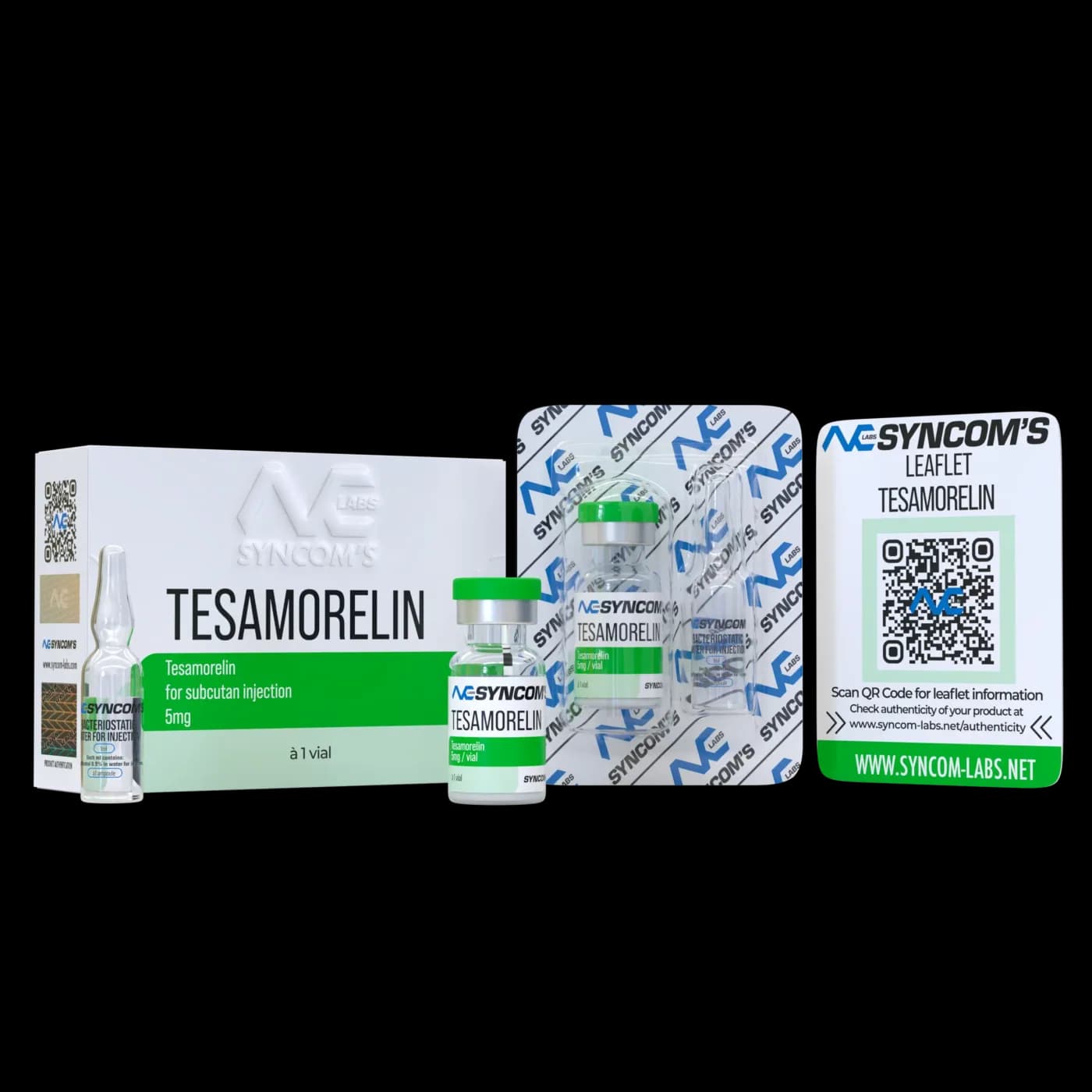
Of the three GHRH approaches in this catalogue, Tesamorelin is the one that kept the full sequence. Sermorelin truncates the parent hormone down to residues 1-29. CJC-1295 takes that same 1-29 fragment and patches four residues to stop it from falling apart. Tesamorelin does something different. It keeps the entire 44-amino acid native chain and protects the vulnerable N-terminus with a single trans-3-hexenoic acid group, a six-carbon unsaturated fatty acid that sits on the front end like a chemical bumper. DPP-IV, the protease that cleaves GHRH at position 2 within minutes of release, cannot get past it.
That trans-3-hexenoyl cap is the entire engineering story. No internal residue swaps, no albumin-binding linker, no D-amino acid substitutions buried inside the chain. Theratechnologies, the Montréal biotech that developed the molecule, kept the full GHRH(1-44) backbone because the receptor-binding work in the 1980s had already established that the longer chain folds tighter against the GHRH receptor than the truncated 1-29 fragment does. The cap solves the half-life problem without rebuilding the rest of the peptide. It is a more conservative design than CJC-1295 and a more elaborate one than Sermorelin, and the resulting plasma stability is somewhere in between.
This compound is the only GHRH analogue ever to clear FDA approval. The original Egrifta brand reached US patients in 2010 for HIV-associated lipodystrophy, the visceral fat accumulation that built up in long-term antiretroviral patients during the older HAART era. A reformulated version, Egrifta SV, followed in 2019 with reduced injection volume and simpler reconstitution. Both came from Theratechnologies. The clinical record behind those approvals, several central Phase III trials measuring visceral adipose tissue by CT scan, sits in the public literature and remains the most extensive prospective dataset on any peptide in this catalogue.
For lab work this matters in two ways. The pharmacokinetic and pharmacodynamic data behind the FDA submission set out clear reference values for GHRH receptor activation, IGF-1 response and visceral adipose endpoints in human subjects, which gives in vitro researchers an anchor point that the other GHRH analogues simply do not have. The synthesis route is also well characterised in the literature, so identity confirmation by mass spec is straightforward. The molecule weighs in at 5135.8 Da, sequence YADAIFTNSYRKVLGQLSARKLLQDIMSRQQGESNQERGARARL with the trans-3-hexenoyl group on the tyrosine.
The lyophilised material holds at minus twenty for long-term storage and refrigerated for shorter spans. Once reconstituted with sterile or bacteriostatic water the working solution stays usable in the fridge for around two weeks, though the trans-3-hexenoyl protection only shields the N-terminus, not the rest of the chain, so freeze-thaw cycles still cost potency. Make up working stocks in small aliquots and dose from those. The peptide is moderately hydrophobic for a GHRH analogue and benefits from gentle swirling rather than vortexing during reconstitution.
Material is held in Hertfordshire and shipped on Royal Mail Tracked 24. Roughly nine in ten UK orders placed before mid-afternoon land the next working day. The batch CoA matching the vial in front of you is posted with the product listing as a PDF and a fresh copy goes out with the shipment. If purity comes back below spec on independent assay, send the trace through live chat and the refund clears the same shift. Bulk orders past ten vials are routed through the support inbox so the price reflects the actual lot rather than a list rate. Chat is staffed by people who can read a HPLC chromatogram during UK business hours.
Sold strictly for in vitro laboratory research. Not for human or veterinary use. UK 18+.
Yes, Tesamorelin can be bought and held in the UK as a research chemical supplied for laboratory use only. It carries no UK marketing authorisation from the MHRA and is not licensed for human use here, despite the US FDA approving it as Egrifta in 2010. We sell it strictly for in-vitro and non-clinical research, not for consumption.
We dispatch from within the UK on a next-day tracked service for orders placed before the daily cut-off, so most researchers have the vial within one to two working days. Tesamorelin ships as a lyophilised powder in a sealed vial. The freeze-dried form is stable at ambient temperature for short transit, so cold-chain shipping is not required to reach you intact.
The CoA is the batch-specific lab record for the exact vials you receive. It reports identity by mass spectrometry, confirming the 5135.86 g/mol GHRH(1-44) target mass, and purity by HPLC, here above 99%. In short, MS shows the right molecule is present and HPLC shows how little else is. We refund or replace any batch that fails its stated spec.
Tesamorelin is a synthetic analogue of human growth-hormone-releasing hormone, the full 44-residue GHRH sequence capped with a trans-3-hexenoic acid group at the N-terminus. Developed by Theratechnologies, published research has examined its effect on growth-hormone and IGF-1 secretion, and in clinical trials its reduction of visceral adipose tissue in HIV-associated lipodystrophy. We supply it for that kind of laboratory work only.
It ships as a lyophilised vial of the 44-amino-acid amide (CAS 218949-48-5, formula C221H366N72O67S, MW 5135.86 g/mol). The N-terminal hexenoyl cap is what slows DPP-IV breakdown. Even so, the molecule clears fast: published pharmacokinetic data report an elimination half-life of roughly 8 minutes in clinical pharmacokinetic studies, which is why the on-file figure is logged as under 60 minutes.
Store the sealed lyophilised vial refrigerated and away from light; the freeze-dried powder is the stable form for long holding. For laboratory reconstitution, bacteriostatic or sterile water is added gently down the vial wall to avoid foaming, then swirled rather than shaken. Reconstituted solution is far less stable than the powder and is typically kept at 2 to 8 degrees C and used within a short window.
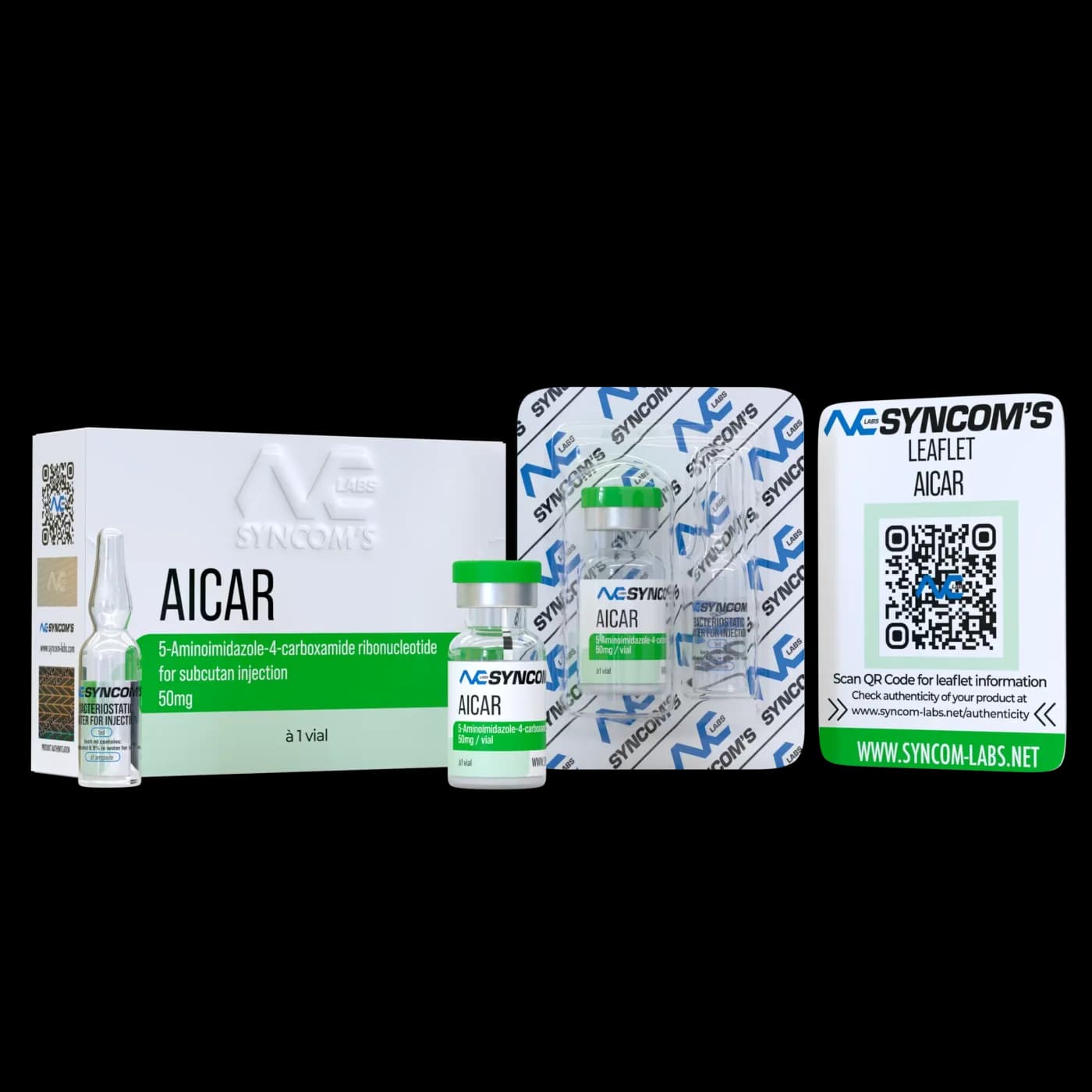
AICAR, an AMPK activator studied for endurance and metabolic research applications. For laboratory research use only.
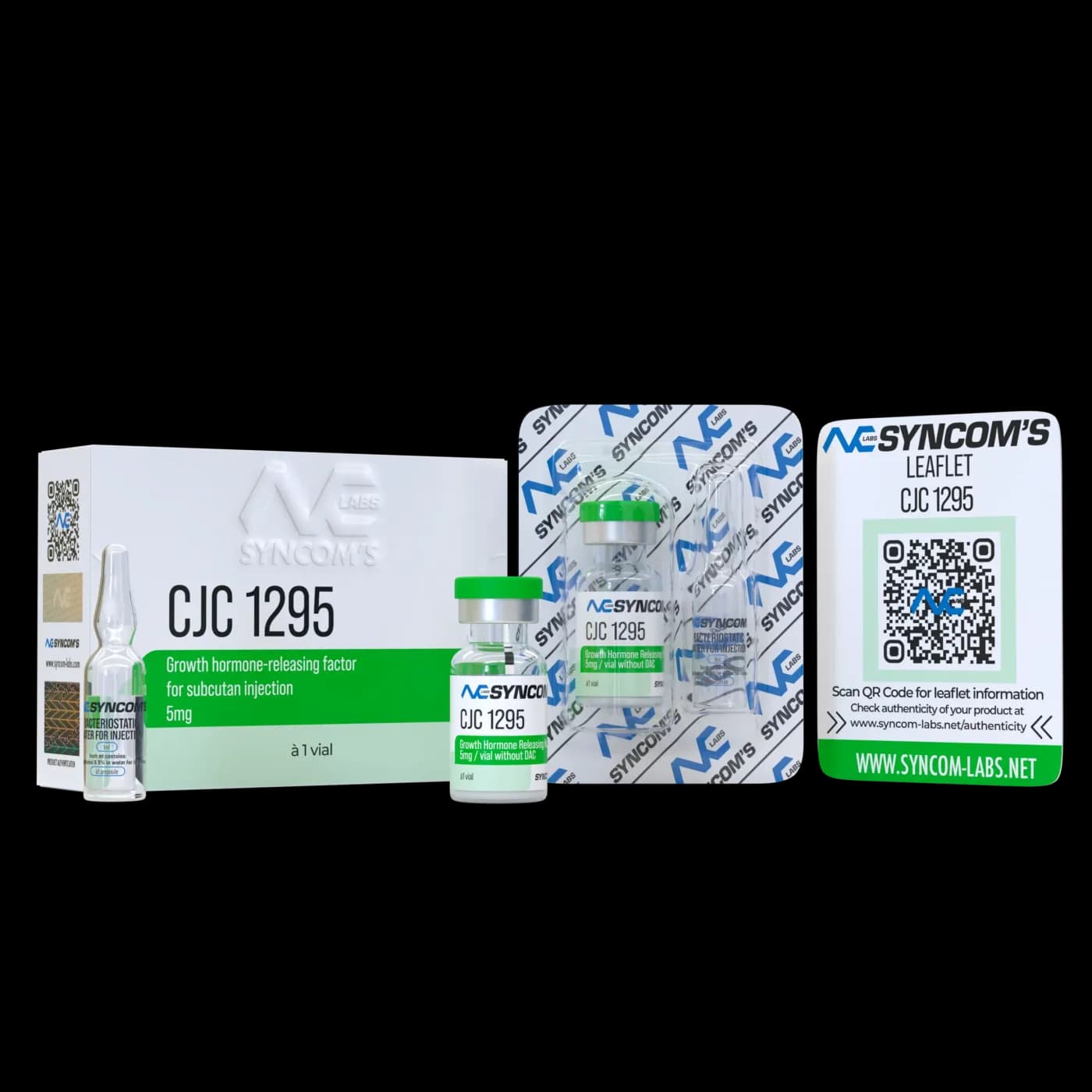
Long-Acting GHRH Analogue
short-acting GHRH