In stock
Growth Hormone Peptides
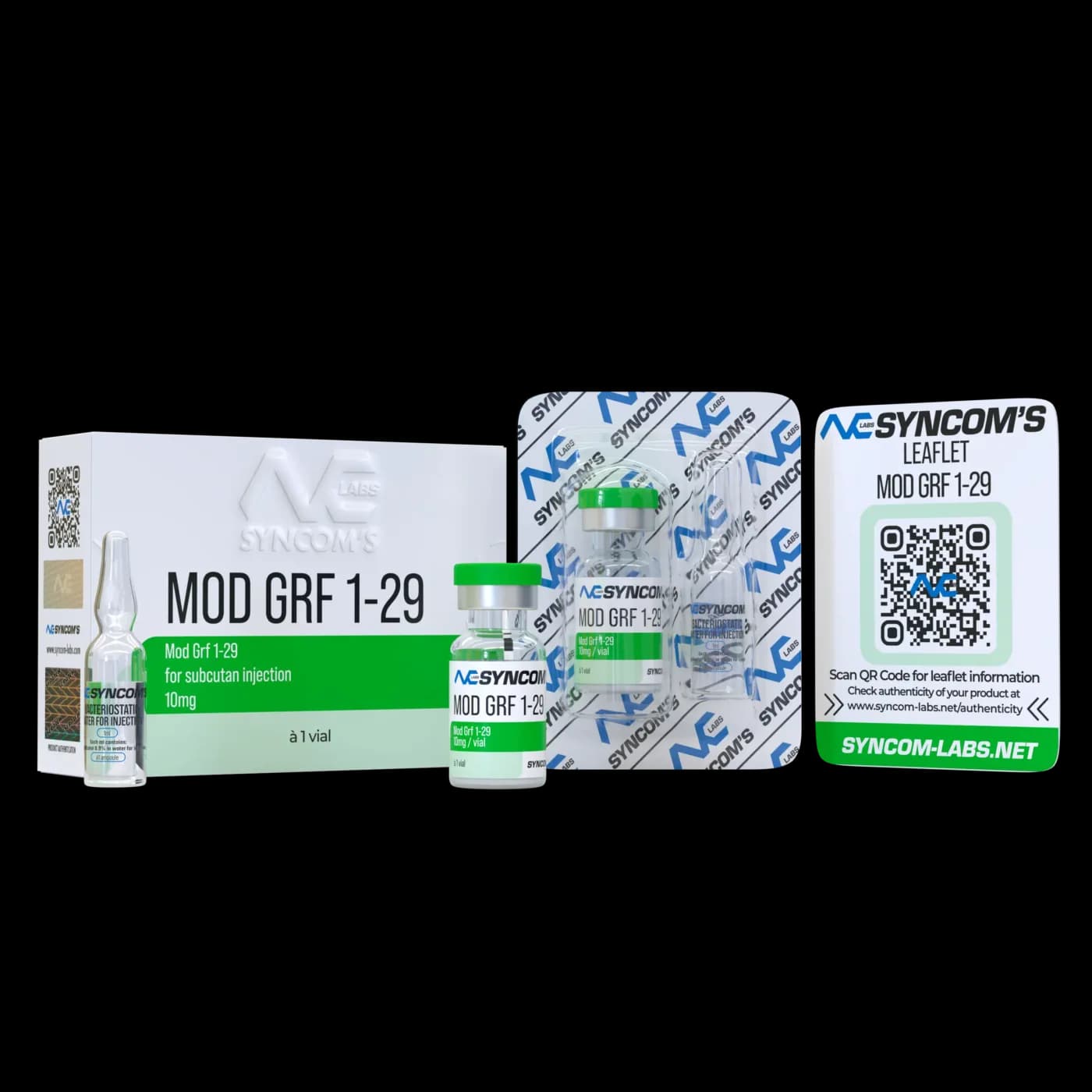
CJC-1295 (no DAC)
short-acting GHRH
>=99% (HPLC) HPLCVial (Lyophilised)CAS 863288-34-0
incl. VAT£24.90
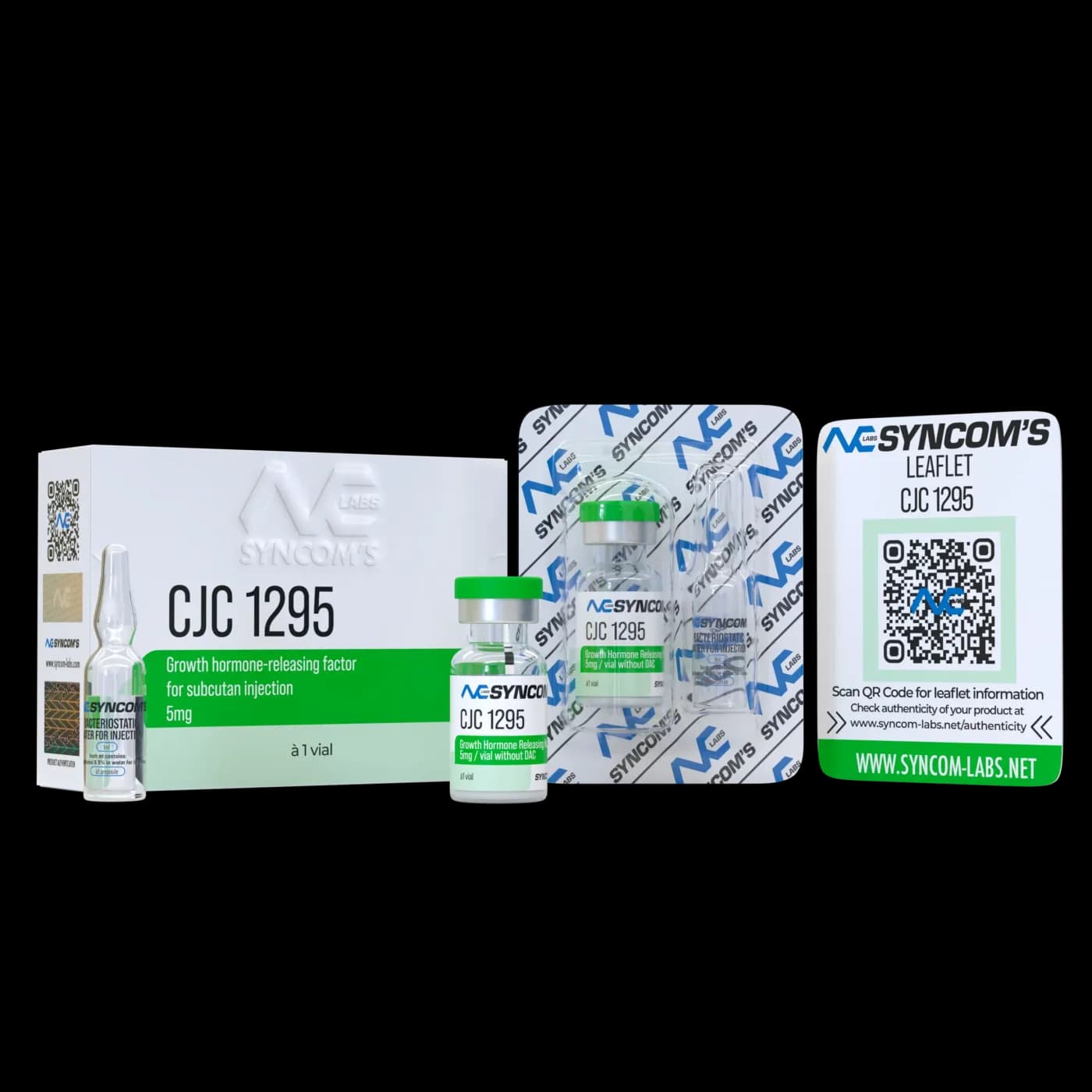
Long-Acting GHRH Analogue
Order before 12:00 on a working day and it ships today
Figures above are the release specification. The certificate shipped with your vial carries the measured values for that specific lot. Email [email protected] with an order number for the raw chromatogram.
The molecule on this page is the DAC-bearing variant of CJC-1295, the one ConjuChem in Montréal pushed through preclinical work and into a Phase 2 trial that ended in 2007. It is chemically distinct from the shorter peptide most labs call CJC-1295 no-DAC (also written as Mod GRF 1-29). Same GHRH(1-29) backbone with the four ConjuChem stabilising substitutions, yes, but with a maleimidopropionic acid arm hanging off the C-terminal lysine. That single addition rewrites how the peptide behaves in plasma.
Maleimide groups react fast and selectively with free thiols. In human blood the most available free thiol is Cys34 on serum albumin. Once injected, the linker reaches that residue and forms a covalent thioether bond, riding the albumin pool around the body for as long as the carrier protein lasts. Reported terminal half-life sits near eight days in human studies, against roughly thirty minutes for the no-DAC peptide. Pulsatile GHRH signalling becomes something closer to a sustained tone, which is exactly why the two molecules are studied for different questions and should not be ordered interchangeably.
Sealed vials hold at minus twenty for long storage. Reconstitute with bacteriostatic water, swirl rather than shake, and the working solution stays usable under refrigeration for several weeks. Albumin binding only happens after the peptide hits a biological matrix containing serum albumin, so in vitro work on albumin-free systems will not see the half-life extension that defines this analogue.
This is the most common mix-up in supplier orders. CJC-1295 DAC and CJC-1295 no-DAC share four residue changes and not much else functionally. No-DAC clears in minutes and reproduces a near-physiological GHRH pulse. DAC sustains GH and IGF-1 elevation for days from a single dose. If your protocol calls for one, the other will not substitute.
Synthesis runs in UK and EU facilities held to GMP-equivalent process controls. Every batch ships with HPLC and mass spec traces tied to the lot number printed on the vial. If a batch CoA falls short of spec on arrival, send the photograph through live chat and a refund or replacement clears the same shift. UK orders dispatched before 3pm land inside 48 hours for roughly nine in ten postcodes.
Ten vials and above unlock tiered pricing handled through the support inbox rather than the cart, mostly because larger orders get reviewed for end-use context first. Live chat runs UK hours with humans on the keyboard who actually answer technical questions.
Sold strictly for in vitro laboratory research. Not for human or veterinary use. UK 18+.
Yes, CJC-1295 DAC can be bought in the UK as a research chemical. It is not a controlled substance under the Misuse of Drugs Act and it holds no MHRA marketing authorisation, so it is supplied strictly for in-vitro and laboratory research, not for human or veterinary use. We ship it labelled as research-use-only material, and that is the only context the compound is sold in.
We dispatch from within the UK on a next-day tracked service for orders placed before the daily cut-off, so most mainland addresses see it the following working day. The lyophilised vial travels at ambient temperature, which the dry powder tolerates fine over short transit. Once it reaches your bench, move it to a fridge or freezer for longer holding.
The batch CoA confirms two things: identity and purity. Mass spectrometry verifies the molecular weight matches CJC-1295 DAC at 3647.25 g/mol, confirming you have the right molecule rather than a mislabelled peptide. HPLC then reports the purity figure, above 98% on our stock. Every vial ships against its own batch document, not a generic template, so the numbers belong to the powder in your hand.
The DAC (Drug Affinity Complex) is a maleimide-lysine tail that bonds covalently to cysteine-34 on serum albumin, turning albumin into a slow-release reservoir. That single addition stretches the half-life from roughly 30 minutes for the no-DAC form (Mod GRF 1-29) to about eight days. In published research the DAC version is used to study sustained GHRH receptor signalling, while no-DAC is used to model short, pulsatile activity.
The lyophilised powder is reconstituted with bacteriostatic or sterile water added slowly down the vial wall, then left to dissolve without shaking. Stored sealed and away from light, the dry powder is stable for extended periods; reconstituted solution is kept refrigerated and used within a few weeks. These handling notes describe laboratory storage of the research material and are not directions for any other use.
Research on CJC-1295 DAC has looked at its action as a long-acting GHRH(1-29) analogue at the growth-hormone-releasing-hormone receptor, and at how albumin binding sustains that signalling over days rather than minutes. Reported in-vitro and animal work examines downstream growth hormone and IGF-1 dynamics. All of this is preclinical; the compound is sold here only as a reference material for that kind of study.
short-acting GHRH