In stock
from£14.90
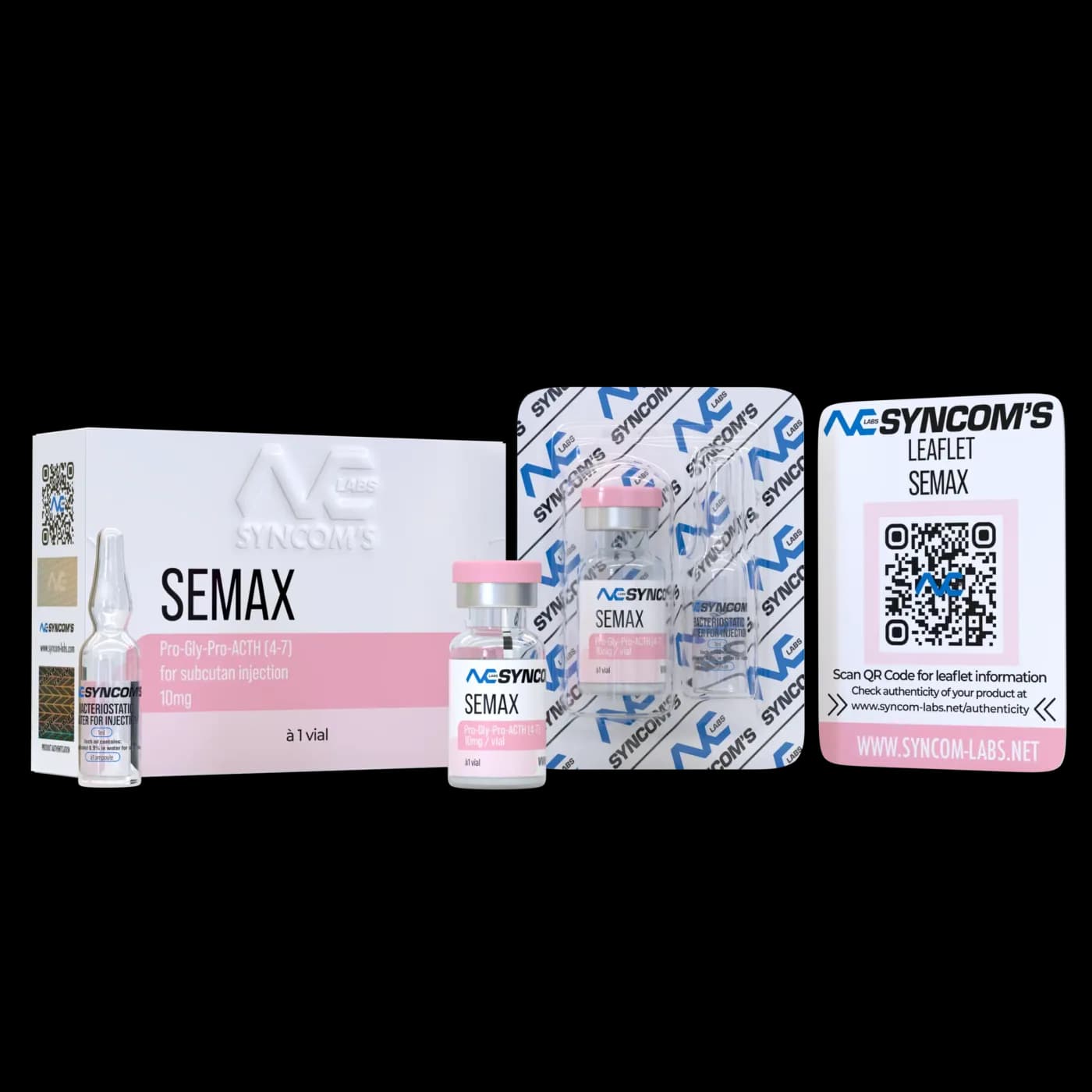
Russian ACTH(4-10) Analogue Nootropic Heptapeptide
Order before 12:00 on a working day and it ships today
Figures above are the release specification. The certificate shipped with your vial carries the measured values for that specific lot. Email [email protected] with an order number for the raw chromatogram.
Semax is the short answer to a longer question Russian neuropharmacologists were asking in the 1980s at the Institute of Molecular Genetics in Moscow: could you keep the cognitive and neurotrophic signalling of ACTH(4-10) without the endocrine baggage of the full hormone? The compound they synthesised is a seven-residue peptide, Met-Glu-His-Phe-Pro-Gly-Pro, with a Pro-Gly-Pro tail tacked onto the ACTH(4-7) core to slow enzymatic breakdown. That small modification is most of the story. It is why Semax has a usable in vivo half-life where the parent fragment does not, and it is why so much of the published work uses intranasal delivery in rodents.
Research interest in Semax sits in a few clear clusters. The largest is neuroprotection in ischaemia models, where Russian groups have published extensively on transient middle cerebral artery occlusion in rats and on transcriptomic responses after the insult. A second cluster looks at BDNF and TrkB signalling, with Semax raising BDNF expression in hippocampal tissue in several rodent studies. A third sits around attention, memory consolidation, and stress endpoints, which is where the ACTH(4-10) lineage shows up most clearly. There is also a smaller body of work on monoamine turnover and on enkephalinase inhibition, the latter being part of why some papers describe an indirect opioidergic component.
For a research peptide, Semax has an unusually long clinical paper trail outside the West. It is registered in Russia and Ukraine for stroke and cognitive indications, which means there is a body of human pharmacokinetic and tolerability data in Russian-language journals that is rare for a compound at this stage elsewhere. For a lab building comparative nootropic or neuroprotective work, that history is part of the appeal.
Purity on our lots runs at 98 percent or better by reverse-phase HPLC, with mass spec confirming the sequence to within 1 Da of the expected 813.9 g/mol. If a vial does not match its CoA on arrival, we refund it. We have not had to do that often, but the policy is real and the inbox that handles it is monitored by a person.
Every batch we list comes from a UK or EU contract peptide manufacturer we have audited. We do not list Semax from unverified Asian suppliers because the failure mode is usually silent counter-ion variation and the occasional misidentified sequence, both of which quietly wreck a study. UK orders placed before late afternoon Monday to Thursday are dispatched the same working day, and around nine out of ten arrive within 48 hours.
Lyophilised Semax is stable at room temperature for short transit windows but should be moved to a freezer at minus 20 C on arrival for long-term storage. Reconstituted in bacteriostatic water, most labs keep it refrigerated and use it within a couple of weeks where peptide integrity matters for the assay. If you need ten or more vials for a multi-arm protocol or a longer time-course, message support for a custom quote rather than running through the cart. Live chat is staffed by humans during UK working hours, and reconstitution or CoA questions get an answer from someone who handles the stock.
Sold strictly for in vitro laboratory research. Not for human or veterinary use. UK 18+.
Yes. Semax is not a controlled drug in the UK and is not scheduled under the Misuse of Drugs Act or the Psychoactive Substances Act 2016, so it can be bought and held for laboratory research. It has no MHRA marketing authorisation as a medicine, which is why it is sold strictly for research use only and not for human or animal use.
Orders placed before our daily cut-off are dispatched same working day, and roughly 90 percent of UK orders arrive within 48 hours on a tracked Royal Mail service. The lyophilised vial ships in discreet, padded packaging. Semax is stable as a dry powder at ambient temperature for the short transit window, so cold-chain shipping is not required.
The batch CoA reports two things measured on the specific lot you receive: HPLC purity (we stock to greater than 98 percent) and mass-spec identity confirming the molecular weight of 813.93 g/mol matches the Met-Glu-His-Phe-Pro-Gly-Pro sequence. It is the paper trail that the powder in the vial is genuinely Semax at the stated purity, not a guess from a generic spec sheet.
Semax is a synthetic heptapeptide based on the 4-10 fragment of the hormone ACTH, with a Pro-Gly-Pro tail added at the C-terminus to slow enzymatic breakdown. It was developed in Russia at the Institute of Molecular Genetics in the 1980s. Catalogues lump it in with growth-factor peptides, but it is a short neuropeptide analogue, structurally unrelated to compounds like BPC-157.
Published in-vitro and animal studies have examined how Semax influences brain-derived neurotrophic factor (BDNF) expression and signalling, along with its activity at melanocortin receptor pathways. The clinical literature is almost entirely Russian and has not been independently replicated in Western trials. This material is supplied for that kind of laboratory investigation only, not for self-experimentation.
For research handling, the lyophilised powder is typically reconstituted with bacteriostatic or sterile water to a known mg/mL concentration based on the vial fill. Keep the sealed vial away from light. Unopened, store frozen for long-term stability; once reconstituted, refrigerate and use within a few weeks. Semax is highly water-soluble, so it dissolves readily in aqueous buffers.
Angiotensin IV Hexamer Analogue, Lipophilic