In stock
from£14.90
N-Acetylated MEHFPGP Heptapeptide Variant
Order before 12:00 on a working day and it ships today
Figures above are the release specification. The certificate shipped with your vial carries the measured values for that specific lot. Email [email protected] with an order number for the raw chromatogram.
The acetyl group at the N-terminus is doing one specific job: blocking the first cut. Unmodified Semax presents a free methionine amine to leucine aminopeptidase and the other N-terminal exopeptidases, which is the dominant first-pass degradation route for short peptides in serum and brain tissue. Cap that amine with an acetyl, and that route closes. The rest of the MEHFPGP backbone is unchanged. What you get is a molecule with the same receptor-facing chemistry as Semax and a measurably longer in vitro half-life in incubations with rat brain homogenate or plasma. That trade is the entire reason this variant exists, and it is the reason research groups working on intranasal or systemic delivery often switch to it after running base Semax first.
The naming around this peptide gets blurry, so it is worth being precise. N-Acetyl Semax is Ac-Met-Glu-His-Phe-Pro-Gly-Pro with a free C-terminal carboxylate. N-Acetyl Semax Amidate is Ac-Met-Glu-His-Phe-Pro-Gly-Pro-NH2, with both ends protected. The amidate version closes the second exopeptidase route as well, at the C-terminus. Some suppliers conflate the two under one SKU; we list them separately because they are chemically distinct compounds with different masses, different CoAs, and different stability profiles. If your protocol cites the amidated form, the non-amidated vial will not behave the same way in a degradation assay.
The base Semax sequence was developed at the Institute of Molecular Genetics in Moscow as a stable ACTH(4-7) analogue with a Pro-Gly-Pro tail. Adding the N-terminal acetyl was a later medicinal-chemistry move, and most of the published characterisation of the acetylated form sits in pharmacokinetic and metabolic-stability papers rather than in the early behavioural literature. If you are familiar with the Russian neuroprotection work on base Semax, the acetylated variant is what shows up when those groups push toward longer dosing intervals or want a cleaner peripheral pharmacokinetic profile in their rodent work.
A non-trivial slice of orders for this peptide comes from labs that have already run a protocol with base Semax and want to repeat it with the acetylated variant as a stability-controlled comparator. The two compounds have the same in vitro receptor-side behaviour at matched concentrations; the difference shows up over time, after several enzymatic half-lives have passed. If that is the comparison you are setting up, order both at the same time so the lots travel together and the CoAs sit next to each other in the binder.
Purity on our lots runs at 98 percent or better by RP-HPLC. The mass-spec confirmation is the part worth checking against your records, because the acetyl shift is the cleanest way to distinguish this peptide from a mislabelled base-Semax vial at receiving. If a vial does not match its CoA on arrival, we refund it. That has been a rare event on this SKU, and the person who handles those messages is the same person who handles the stock.
Every batch comes from a UK or EU contract peptide house we have audited in person or through documentation. We avoid unverified Asian supply for the acetylated variants in particular, because the failure modes (incomplete acetylation giving a mixed-population vial, or counter-ion swaps that change the salt mass) are silent on a casual visual check and only surface in the mass spec. UK orders placed Monday to Thursday by late afternoon go out the same working day, and around nine in ten land within 48 hours.
Keep the lyophilised powder at minus 20 C for any storage beyond the transit window. Reconstituted in bacteriostatic water, most groups refrigerate it and use it within a couple of weeks where the stability gain over base Semax is the whole point of using the acetylated form. For ten or more vials, message support for a custom quote rather than going through the cart. Live chat during UK hours is staffed by people who work with the stock, so reconstitution and CoA questions get answered properly rather than routed through a script.
Sold strictly for in vitro laboratory research. Not for human or veterinary use. UK 18+.
Yes, N-Acetyl Semax is legal to buy in the UK when sold and used strictly as a research chemical. It is not a licensed medicine and is not approved for human or animal use, so it is supplied for in-vitro and laboratory research only. We sell to researchers and informed buyers who understand that condition. It is not a controlled substance under the Misuse of Drugs Act.
We dispatch from the UK, so orders placed before the daily cut-off ship the same working day with tracked next-day delivery in most cases. The lyophilised peptide ships in a sealed vial and is stable at ambient temperature for the short time it spends in transit, so no cold chain is needed for shipping. Store it properly once it arrives.
The batch CoA confirms two things that matter most for peptide work: identity and purity. Mass spectrometry verifies the molecule is Ac-MEHFPGP at the expected mass, and reverse-phase HPLC reports the purity percentage for that specific lot. Every vial is tied to the batch it came from, so the figures on the certificate match what is in your hand, not a generic spec sheet.
N-Acetyl Semax is the heptapeptide Semax (Met-Glu-His-Phe-Pro-Gly-Pro) with an acetyl group capping the N-terminal methionine. Semax itself derives from the ACTH(4-10) fragment and was developed in the 1980s by Ashmarin and Myasoedov at the Russian Academy of Sciences. The acetyl cap blocks the free amine that aminopeptidases attack first, which is the structural point of the modification.
Aminopeptidases degrade small peptides by clipping residues from the exposed N-terminal amine, and unmodified Semax has an in-vitro plasma half-life of only minutes. Acetylating that amine removes the handle those enzymes grab, which in published work extends measured stability. Research on the Semax family has looked at BDNF and NGF expression, neuroprotection in ischaemia models, and effects on attention and memory in animals.
Keep the sealed lyophilised vial at -20C, away from light and moisture, where it stays stable for long-term storage. For research reconstitution, add bacteriostatic water slowly down the vial wall and swirl gently rather than shaking, which protects the peptide. Once in solution, hold it at 2-8C and use within about four weeks. Avoid repeated freeze-thaw cycles of the reconstituted material.
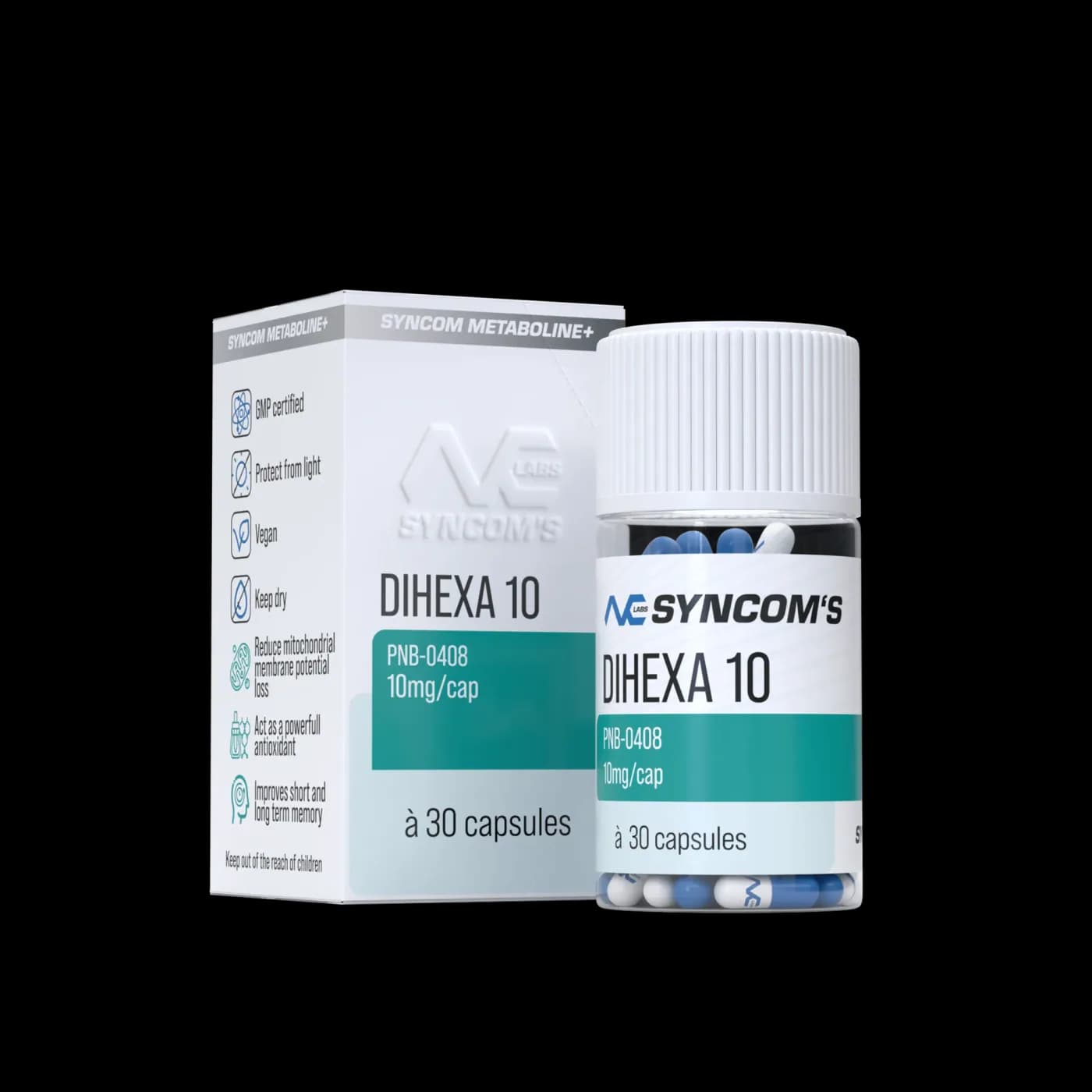
Angiotensin IV Hexamer Analogue, Lipophilic