In stock
Growth Hormone Peptides
CJC-1295 DAC
Long-Acting GHRH Analogue
>98% HPLCVial (Lyophilised)CAS 446262-90-4
incl. VAT£44.90
SKF-110679
Order before 12:00 on a working day and it ships today
Figures above are the release specification. The certificate shipped with your vial carries the measured values for that specific lot. Email [email protected] with an order number for the raw chromatogram.
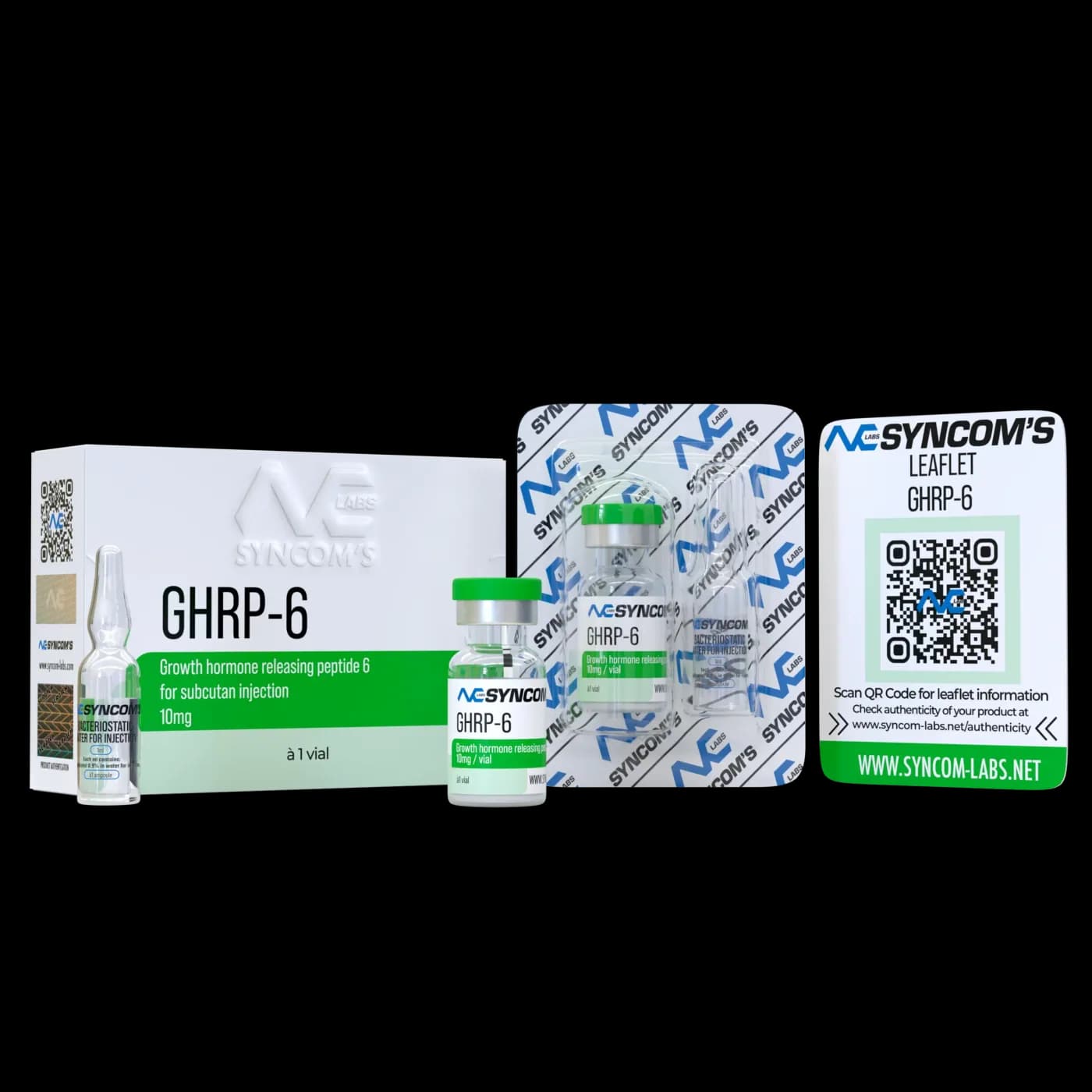
GHRP-6 is the molecule that gave the whole growth hormone releasing peptide family its name. Cyril Y. Bowers and colleagues at Tulane University reported the hexapeptide in 1984, building on the enkephalin work that had hinted a non-GHRH route to growth hormone release was possible. The sequence is His-D-Trp-Ala-Trp-D-Phe-Lys-NH2, six residues with two D-amino acids for proteolytic stability, and it became the reference compound every later GHRP was measured against in pituitary cell assays.
Before GHRP-6 there was no GHRP class. Bowers had been chasing the active fragment for years, and the 1984 hexapeptide was the first synthetic ligand that released growth hormone reliably in vitro and in vivo through a receptor that was not the GHRH receptor. That orphan receptor was eventually identified in 1996 and renamed the ghrelin receptor (GHS-R1a) when the endogenous ligand was found in 1999. For literature searches, GHRP-6 is the entry point: most receptor characterisation papers from the 1990s used it as the prototypical agonist.
SmithKline Beecham picked up GHRP-6 for clinical investigation under the internal development code SKF-110679. Pharmacology references and old patent filings will list both names interchangeably. If a paper cites SKF-110679 and you cannot place the compound, it is the same hexapeptide on your vial. The CAS number for the acetate salt is 87616-84-0, and molecular weight runs at 872.4 g/mol for the free base.
Among the GHRPs, GHRP-6 is the one that consistently produces a marked feeding response in rodent models, generally read as ghrelin-receptor activation feeding into hypothalamic NPY and AgRP neurons. Later peptides in the family, including GHRP-2 and Ipamorelin, were partly designed to dial that effect down while keeping GH release intact. For appetite and energy-balance researchers, that is the reason GHRP-6 still has a place on the bench even with newer secretagogues available. The same effect is why direct comparison studies almost always include GHRP-6 as the positive feeding control.
GHRP-6 binds GHS-R1a on pituitary somatotrophs and on hypothalamic neurons. It has no measurable affinity for the GHRH receptor, which is the cleanest way to separate it from peptides like Sermorelin or CJC-1295. Reported acute effects in animal work include amplified GH pulses, a transient appetite spike, and modest changes in gastric motility. Cortisol and prolactin responses are present but generally smaller than those reported for Hexarelin in matched protocols.
Each vial holds lyophilised GHRP-6 acetate, synthesised through UK and EU peptide manufacturers we work with directly rather than relabelled stock from open marketplaces. Every batch is released against HPLC for purity and mass spectrometry for identity, and the CoA tied to the lot number on your vial can be pulled on live chat before or after the order. If any vial fails to match its CoA on independent testing, the order is refunded in full.
About nine in ten UK orders ship and arrive inside 48 hours. Live chat is staffed in UK hours by people who can read batch documentation while you are on the line. For studies needing ten vials or more, contact support for tiered pricing rather than stacking the cart at the listed unit price.
Sold strictly for in vitro laboratory research. Not for human or veterinary use. UK 18+.
Yes. GHRP-6 is legal to buy and supply in the UK for laboratory research only. It is not a licensed medicine and is not approved for human or veterinary use, so it cannot be sold for consumption. We ship it labelled for in-vitro and animal research, and every order goes to researchers who accept those research-use terms at checkout.
We dispatch from within the UK, so orders placed on a working day before our cut-off usually go out same day for next-day arrival. The lyophilised vial is stable at ambient temperature for the short transit window and travels in protective packaging. Keep it away from light and refrigerate or freeze on arrival; reconstitute only when you are ready to run your work.
The CoA pairs two tests. HPLC measures purity as the main peak's share of total UV-absorbing material, which is where our greater than 98 percent figure comes from. Mass spectrometry confirms identity by matching the measured mass to the GHRP-6 sequence. Together they show you have the correct hexapeptide at the stated purity for that specific batch. We send the batch CoA on request.
GHRP-6 is a synthetic hexapeptide growth hormone secretagogue, sequence His-D-Trp-Ala-Trp-D-Phe-Lys-NH2, also catalogued as SKF-110679. It came out of Cyril Bowers' work in the 1980s and was one of the tool compounds that led to the 1999 identification of ghrelin as the natural ligand for the GHS-R1a receptor. It is a peptide, not a steroid or a small-molecule drug.
Published work has looked at GHRP-6 as an agonist at the ghrelin receptor (GHS-R1a), where it triggers growth hormone release from pituitary somatotrophs through the phospholipase C calcium pathway. A recurring finding in animal studies is a marked appetite signal, which is the trait most often used to separate it from GHRP-2. All of this is in-vitro and animal data; we make no human claims.
Store the sealed lyophilised vial cold and out of light; long term, minus 20C keeps it stable. For research handling the powder is typically reconstituted with bacteriostatic or sterile water added gently down the vial wall, not injected into the cake. Once in solution, keep it refrigerated at 2 to 8C and use it within a few weeks, or aliquot and freeze to limit freeze-thaw cycles.
Long-Acting GHRH Analogue
short-acting GHRH