In stock
Growth Hormone Peptides
CJC-1295 DAC
Long-Acting GHRH Analogue
>98% HPLCVial (Lyophilised)CAS 446262-90-4
incl. VAT£44.90
Examorelin
Order before 12:00 on a working day and it ships today
Figures above are the release specification. The certificate shipped with your vial carries the measured values for that specific lot. Email [email protected] with an order number for the raw chromatogram.
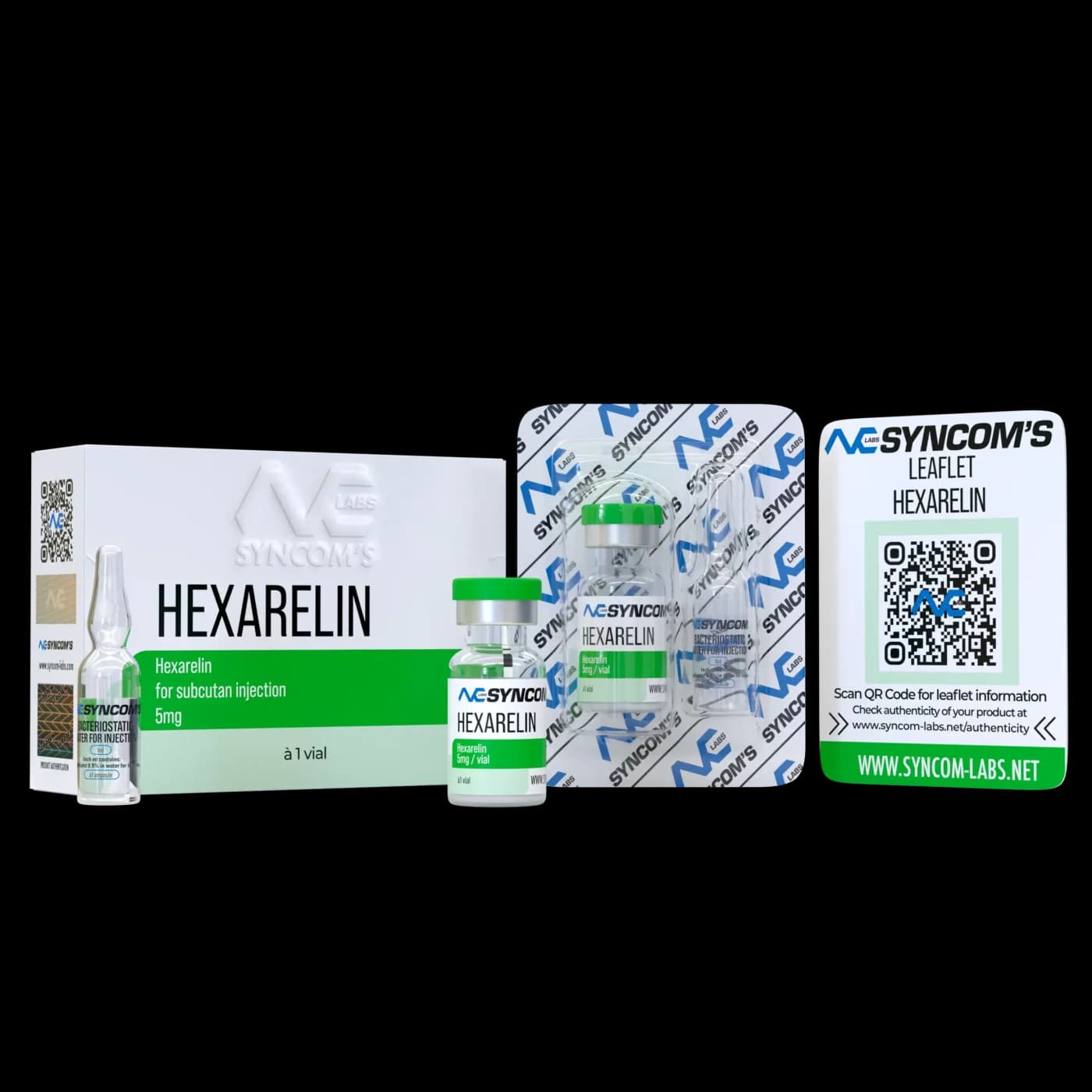
Hexarelin was put together in the early 1990s by Romano Deghenghi and the Mediolanum Farmaceutici group in Milan, with later development passing through Pharmacia Italy. It carries the International Nonproprietary Name Examorelin, which is the label most pharmacological reference databases file the molecule under, even though almost nobody uses that name in the lab. The compound is a six-residue peptide with the sequence His-D-2-methyl-Trp-Ala-Trp-D-Phe-Lys-NH2, and that small methyl group on the tryptophan at position 2 is the entire reason it exists as a separate molecule rather than a footnote to GHRP-6.
If you strip the 2-methyl out of the tryptophan, what is left is essentially GHRP-6. The 2-methyl-Trp modification slows enzymatic clearance and tightens the fit at the ghrelin receptor (GHS-R1a), and in published rat pituitary work Examorelin came out roughly an order of magnitude more potent per microgram than the parent compound on acute GH release. That difference is the headline data point in nearly every comparison paper in the Deghenghi files.
Most ghrelin-family work treats GHS-R1a as the only address the molecule visits. Hexarelin is unusual because it also binds CD36, the fatty acid translocase expressed on cardiomyocytes and macrophages, and a chunk of the published research on this peptide is built around that off-target site. The cardioprotection signal in rat infarct and isolated heart models, including work by Berti and the Locatelli group in Milan, traces back to CD36 binding rather than to the pituitary axis. If you are pulling references for a cardiac protocol rather than a somatotroph one, that is where the relevant literature sits.
One of the consistent observations in the older human and animal pharmacology files is that the GH response to repeated Hexarelin dosing flattens over weeks of continuous exposure, while the acute single-dose response stays sharp. That is a useful design point for any study that runs longer than a few days, and it is the reason the molecule found its diagnostic niche in GH provocation testing rather than as a long-run secretagogue tool.
Each unit is lyophilised Examorelin acetate. Synthesis comes through UK and EU peptide manufacturers we have held long-running supply relationships with, never relabelled bulk from open marketplaces. Every batch is released against HPLC for purity and mass spectrometry for identity, and the CoA carrying the lot number printed on your vial can be requested through live chat before or after the order. If a vial ever fails to match its CoA on independent testing, the order is refunded in full.
Around nine in ten UK orders leave the warehouse and reach the customer inside 48 hours. Live chat is run by people in UK working hours who can pull batch paperwork while you are still on the line. For studies needing ten vials or more, contact support directly rather than stacking the cart at retail, and pricing is reworked from there.
Sold strictly for in vitro laboratory research. Not for human or veterinary use. UK 18+.
Yes, Hexarelin can be bought and held in the UK as a research chemical, supplied strictly for laboratory and in-vitro use. It is not a licensed medicine and is not approved for human or veterinary use, so we sell it for research purposes only. Note that Hexarelin is on the WADA prohibited list, which rules it out of any sporting context.
Around 90% of UK orders go out within 48 hours, with most arriving next day on a tracked Royal Mail service. The lyophilised vial is a stable freeze-dried powder, so it ships at ambient temperature in protective packaging without needing cold chain. On arrival, store it away from light and refrigerate for longer holding. We dispatch from UK and EU stock.
The CoA reports batch identity and purity from two independent methods. HPLC (high-performance liquid chromatography) gives the purity figure, above 99% for this batch, by separating the target peptide from process impurities. Mass spectrometry confirms the molecular weight matches the expected 887.06 g/mol, verifying you have Hexarelin and not a mislabelled or degraded peptide. Both data sets are kept per lot.
Hexarelin is a synthetic hexapeptide and a growth hormone secretagogue that acts as an agonist at the GHS-R1a (ghrelin) receptor. It was developed in the 1990s by the Italian group around Romano Deghenghi. Published in-vitro and animal research has looked at its effect on growth hormone release from the pituitary and at GHS-R signalling and cardiac tissue. All findings are preclinical; we make no claims about effects in humans.
The sequence is His-D-2-methyl-Trp-Ala-Trp-D-Phe-Lys-NH2, a six-residue peptide with a C-terminal amide. The position-2 residue is a 2-methyl-tryptophan in the D-configuration. In published structure-activity work this modification was used to raise metabolic stability and receptor potency relative to earlier GHRP-6-type peptides, which is part of why Hexarelin became a reference secretagogue in the literature.
Reconstitute the lyophilised powder with bacteriostatic or sterile water added slowly down the vial wall, then swirl rather than shake until dissolved; researchers pick the volume to suit their assay concentration. Keep the sealed vial away from light and refrigerated before use. Once reconstituted, hold it refrigerated and use within a few weeks. The dry powder is the most stable form for longer storage.
Long-Acting GHRH Analogue
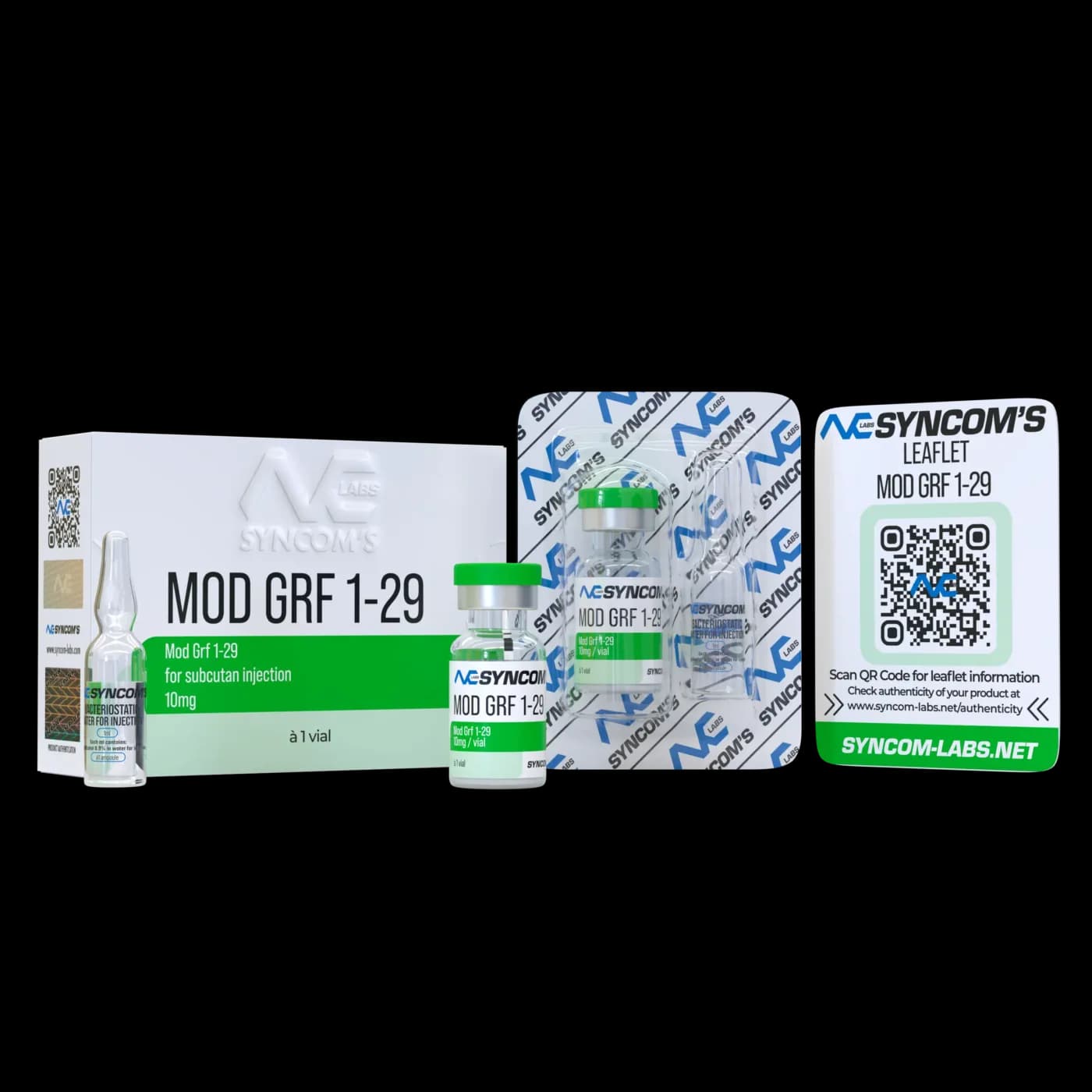
short-acting GHRH