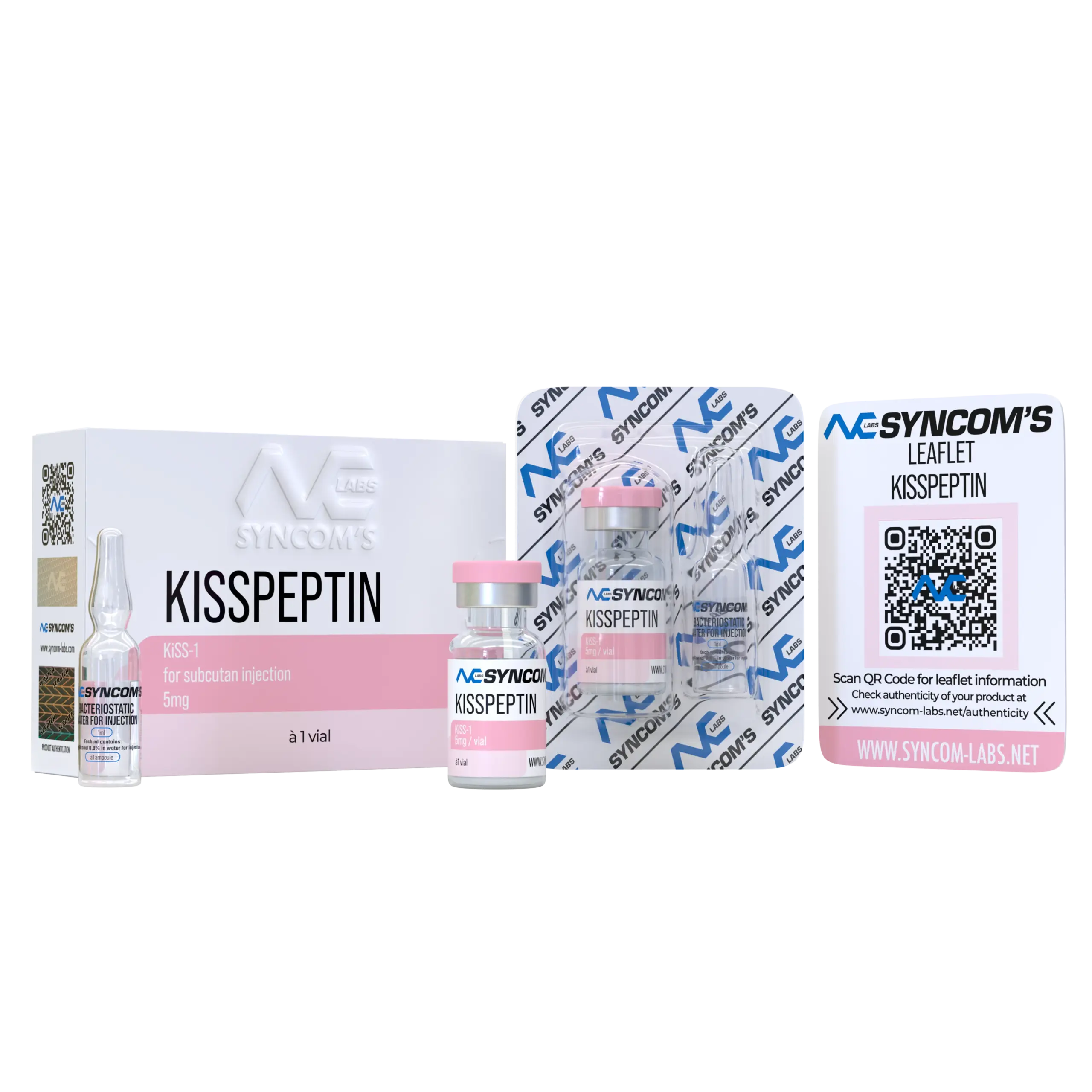
Description
Named after a chocolate, decoded in a hypothalamus
The KISS1 gene was christened in Hershey, Pennsylvania in 1996. Danny Welch and the Penn State team that identified it as a metastasis suppressor in melanoma cell lines were working a short walk from the chocolate factory, and they let the postcode do the naming. The protein they pulled out was called metastin, and for several years the biology stayed inside cancer journals.
What flipped the field was a pair of 2003 papers in the New England Journal of Medicine. Stephanie Seminara at Massachusetts General and Nicolas de Roux in Paris independently reported families with hypogonadotropic hypogonadism whose only obvious lesion was an inactivating mutation in GPR54, the orphan receptor that metastin happened to bind. The cancer peptide turned out to be the central trigger for puberty. Once that link was made the gene product was renamed kisspeptin, and Kisspeptin-10 (YNWNSFGLRF-NH2) is the 10-amino-acid C-terminal fragment that retains essentially full activity at the receptor.
What the vial contains
- Sequence: YNWNSFGLRF-NH2 (10-aa C-terminal fragment, residues 112-121 of human kisspeptin)
- Receptor: GPR54, also catalogued as KISS1R
- Gene of origin: KISS1 on chromosome 1q32
- Original alias: metastin (45-54), from the metastasis-suppressor literature
- Form supplied: lyophilised powder, sealed amber vial
- Purity check: HPLC plus mass spec, lot-specific CoA on request
The master switch upstream of GnRH
If you draw the HPG axis as the textbooks do, GnRH neurons in the hypothalamus fire pulses, the pituitary answers with LH and FSH, and the gonads do the rest. The honest version of that diagram puts one more box above GnRH: a small population of kisspeptin neurons in the arcuate nucleus and the preoptic area that decide when GnRH is allowed to pulse at all. Kp-10 is the experimental tool that lets a wet lab poke that switch directly.
Published in vitro and animal work uses Kp-10 in three broad ways. Receptor pharmacology groups characterise Gq coupling, IP3 and calcium responses, and beta-arrestin recruitment at KISS1R. Reproductive endocrinology labs track LH pulse architecture in rodent and primate models after Kp-10 infusion. A third strand, mostly out of Waljit Dhillo’s group at Imperial College London, has carried kisspeptin biology into human IVF and hypogonadism research, including kisspeptin-triggered oocyte maturation protocols that have now been through multiple clinical trials. None of that is permission to dose anything. It is the citation map a planning researcher tends to start with.
UK delivery and how the bench team works
Stock lives in our UK facility. Tracked carriers, plain outer packaging, and around nine in ten UK orders are delivered inside 48 hours. The support inbox is answered by people on UK working hours, not a ticket robot, and the same team quotes bulk pricing (ten vials or more) off the public listing if a lab is sizing up a longer study.
Every Kp-10 lot ships with an HPLC and mass spec result tied to that exact batch. If the CoA does not clear our purity threshold once it is in your hands, we refund the vial.
Bench questions worth answering up front
- Reconstitution medium? Sterile water or a mildly acidic aqueous buffer dissolves the lyophilised powder cleanly. Swirl, do not vortex. Hold the reconstituted solution at 2 to 8 degrees C and use within the working window your protocol allows.
- Half-life caveat? Kp-10 is rapidly degraded in serum in published pharmacokinetic work, which is why most in vivo studies use infusion or repeated bolus designs rather than single shots. Worth modelling before assay design.
- Kp-10 vs Kp-54? Kp-54 is the full-length mature peptide. Kp-10 is the C-terminal decapeptide and is the most studied agonist fragment, with comparable potency at KISS1R in most published binding assays.
- Dry storage? Sealed vial at -20 degrees C, protected from light and moisture, for the shelf life printed on the CoA.
Sold strictly for in vitro laboratory research. Not for human or veterinary use. UK 18+.